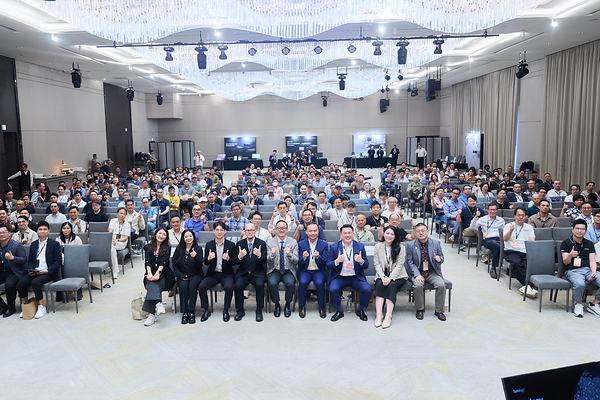
Synology Solution Day 2026 concluded successfully on the 23rd, drawing over 300 enterprise IT professionals. Attendees gained in-depth insights into Synology’s comprehensive suite of solutions—covering data storage, data protection, team productivity, video surveillance, and digital asset management—designed to help organizations maintain data sovereignty in the age of AI.
This year also marks a major milestone: the 20th anniversary of Synology DSM. Having evolved from a simple storage operating system into a robust platform that enterprises rely on for storage, protection, collaboration, surveillance, and AI-driven operations, Synology has now shipped 14 million systems globally, safeguarding over 400 exabytes (EB) of data.
“The effectiveness of AI depends on the data behind it,” noted Andrew Huang, Regional Business Manager at Synology. “The AI model itself is no longer the primary hurdle; the real challenge lies in the underlying data—an area for which most organizations are not yet prepared. Enterprise data is often scattered across various locations and applications. While files, emails, conversations, and video footage contain vital corporate knowledge, they have historically been difficult for computers to interpret. Furthermore, migrating this data to the cloud introduces concerns regarding costs, data sensitivity, and regulatory constraints. The more valuable the data, the harder it is to move—and the more critical it becomes to keep it within an organization’s own infrastructure.”
Augustine Ng, Chief Specialist for Strategic Alliances in Asia at Toshiba Storage, who also participated in the event, remarked: “AI requires trustworthy data; trustworthy data requires secure storage; and secure storage requires a reliable infrastructure.” By combining enterprise-grade storage technology with practical data management capabilities, Toshiba HDDs and Synology work together to build this essential foundation. Gathering industry insights, this session explored how enterprises can prepare their data for AI applications.
Moderated by David Ip, Founding Chairman of the Hong Kong Cyber Security Association (HKCNSA), the panel featured Jimmy Chan, Vice Chairman of the Hong Kong Association for Computer Education (HKACE), and Andy Chu, Lead of Deal Pursuit at system integrator Senco-Masslink. The discussion, titled “From Data Readiness to AI Value: Data Control, Costs, and Operational Resilience,” examined practical strategies—from the perspectives of both enterprises and educational institutions—for overcoming challenges such as data fragmentation, version inconsistency, and ambiguous access permissions. The panelists discussed how to ensure that AI models utilize the correct data under appropriate access controls to deliver tangible operational benefits. They also highlighted the importance for enterprises to holistically evaluate the long-term costs associated with data storage, AI usage, data transmission, and protection, while maintaining a clear understanding of where critical data is stored and how it is being used.
Regarding data control and operational resilience, the discussion illustrated how Synology solutions help enterprises integrate management requirements into their daily operations. For instance, the Synology AI Console can mask sensitive information—based on administrator-defined policies—before forwarding requests to external AI services. When combined with data classification and access management, this significantly reduces the risk of unnecessary data exposure. Additionally, ActiveProtect enables enterprises to implement off-site backups, immutable data protection, and backup verification tailored to specific workloads. The panelists emphasized that a successful backup does not guarantee a successful recovery; therefore, enterprises must conduct regular drills to ensure that critical data and services can be restored within acceptable timeframes and data-loss thresholds, thereby maintaining full control over their digital assets.
In terms of data storage, Synology showcased the PAS7700, designed for mission-critical workloads, and the GS3400—a scale-out model built for unstructured data and the first to support S3 object storage. These solutions address a diverse range of enterprise needs, while the Synology Tiering mechanism allows organizations to balance performance with expenditure, even as storage costs continue to rise. In terms of data protection, Synology continues to expand the scope of its ActiveProtect solution, extending coverage to public cloud hosts, cloud services, and mainstream enterprise virtualization platforms such as Nutanix AHV and Proxmox VE. Looking ahead, the integration of AI technology will introduce anomaly detection and automated rollback mechanisms, further strengthening backup security and ensuring that organizations can restore their data to a clean, uncompromised state.
Regarding team productivity, the Synology Office Suite enables collaboration while allowing organizations to retain full autonomy over their data. New communication platforms—ChatPlus and Meet—are built entirely on the organization’s own infrastructure, ensuring both privacy and granular permission management.
For intelligent video surveillance, Synology maintains a comprehensive hybrid cloud ecosystem. Enterprises can choose between on-premises Surveillance Station or the cloud-based Surveillance365 (which requires no local server deployment). A hybrid cloud platform is also in the pipeline, offering organizations the flexibility to decide where their surveillance operations reside. Furthermore, Synology Photos has evolved for enterprise use; by leveraging AI, automated categorization, and OCR (Optical Character Recognition), it extracts valuable information from images—unlocking their business potential—with all recognition and processing performed locally on the organization’s own hardware.
Andrew Huang concludes: “Regardless of how technology evolves, data remains the foundation. Therefore, our focus—across storage, productivity, data protection, and video surveillance—is to bring AI closer to the data, ensure that data remains under the organization’s control, and guarantee its security across both digital and physical environments.”